
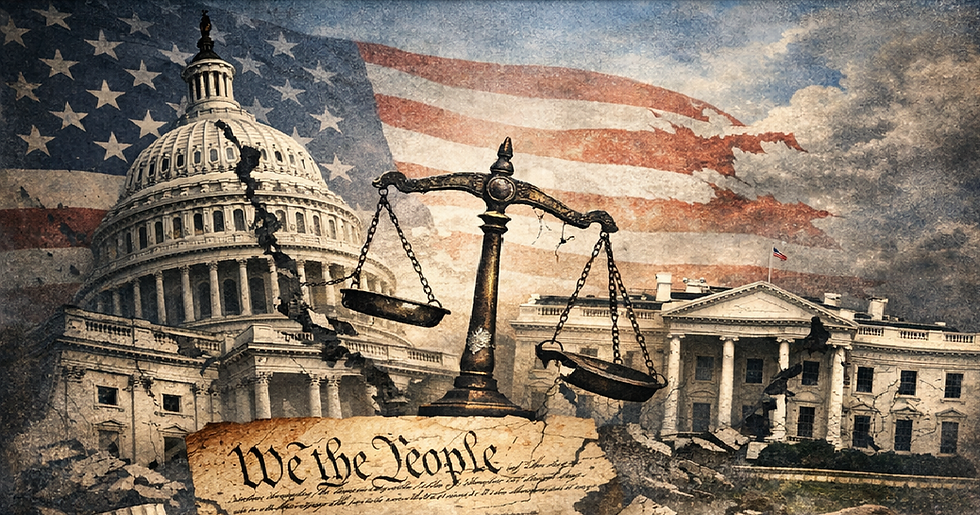
Proposed Guiding Principles to the Constitutional Convention of the United States
Updated: Jan 19

(Rights, Duties, and Modern Governance)
Section 1. Good Faith, Reasonableness, and Duty of Care
The people have the right to expect that their government shall act in good faith in all interactions with the people.
All officers, agents, and employees of the federal, state, and local governments shall discharge their duties according to the highest reasonable standard of conduct.
The convention will provide a universal guide defining “reasonableness” and “duty of care” as they apply to public service and jurisprudence.
No branch, agency, or subdivision of government shall be exempt from these standards.
Section 2. Limitation of Power and Oversight
No power granted to any branch of government, whether exercised separately or jointly, shall be absolute.
Legislative action, executive enforcement, and judicial review shall remain subject to prudence, reason, and meaningful oversight.
The judiciary shall retain authority to review and restrain actions of the legislative and executive branches that exceed constitutional bounds.
Section 3. Equality of Persons
All people are equal before the law.
Citizenship may confer specific civic and monetary benefits, including but not limited to public education and social insurance, which need not be extended to non-citizens.
All persons within the jurisdiction of the United States are entitled to equal consideration and protection of the laws.
Congress may by law provide a framework for recognizing additional classes of persons upon a showing of autonomy, meta-awareness, and moral agency.
Section 4. Habeas Corpus and Confinement
The people retain the absolute right to contest confinement by the government.
The privilege of the writ of habeas corpus shall not be suspended under any circumstances.
Section 5. Separation of Church and State
Church and state shall remain separate.
No religion shall be established as a national or preferred religion.
All people retain the right to freely exercise religion or to reject religion entirely.
No public funds shall be used to advance religious doctrine.
No publicly funded institution or agent of the state shall engage in religious advocacy while discharging official duties.
Section 6. Elections and Representation
All citizens shall be automatically registered to vote upon attaining the age of majority or upon naturalization.
Only citizens of the United States may vote in elections for any public office within the United States.
All persons within the jurisdiction of the United States, whether permanent or temporary, shall be counted for purposes of representation by the census.
Section 7. Transparency, Public Interest, and the Right to Know
The people have the right to transparency in the actions of their government.
Government records shall be disclosed to the public not later than twenty-five years after their creation, unless continued classification is justified through periodic judicial review.
The people retain the right to request information regarding past, present, or planned government actions.
Permissible redactions under ordinary disclosure shall be limited to: a. Personally identifiable information of individuals or entities not responsible for wrongdoing; and
b. Active intelligence methods or narrowly tailored strategic planning, the disclosure of which would pose a demonstrable and ongoing threat to public safety or national security.
Public Interest Disclosure.
When a matter has risen to substantial public interest, the government shall have an affirmative duty to disclose all relevant records necessary for public understanding of the matter.
Mandatory Disclosure of Illegality.
Any action undertaken by the government that is unlawful under the Constitution or laws of the United States shall be fully disclosed to the people.
Disclosure under clauses (5) and (6) shall not be subject to ordinary classification or secrecy rules.
The sole permissible redaction under clauses (5) and (6) shall be the removal of personally identifiable information of individuals or entities not perpetrating the unlawful conduct.
All redactions shall be specifically identified and justified in writing and shall be subject to immediate judicial review.
Any citizen who has accessed a record containing a redaction shall have standing to challenge the propriety of the redaction.
A reviewing justice may order the release of any material found to be improperly withheld or redacted.
Section 8. Digital Privacy and Modern Searches
The people have the right to digital privacy.
Data collected by the government shall be maintained in confidence and shall not be transferred to third parties.
Access to such data for criminal investigation requires a specific warrant based on probable cause.
General or bulk warrants are prohibited.
The people have the right to know how their data is used and may refuse non-essential uses without penalty or loss of service.
Modern technology shall not be employed in a manner that constitutes unreasonable search or seizure.
Section 9. Detention and Probable Cause
No person shall be detained by the government absent probable cause.
Section 10. Overbreadth of Law
Laws that, under reasonable circumstances, may be expected to criminalize lawful, protected, or ordinary conduct are unconstitutionally overbroad.
Such laws are void.
Section 11. Property and Financial Autonomy
The people retain the right to control and dispose of their financial assets.
Assets may be frozen only upon a showing of probable cause and issuance of a valid court order.
Government shall not otherwise direct or restrict the use, transfer, or disposition of private assets or property.
Section 12. Propaganda and Manipulation
The government shall not engage in propaganda or the manipulation of public opinion directed at the people.
Any exception based on compelling state interest shall be narrowly tailored and subject to judicial review.
Section 13. Forfeiture
Civil asset forfeiture is prohibited.
Criminal asset forfeiture is permitted only upon conviction.
Forfeited assets shall first be applied to compensate victims, with any remainder distributed to public victim compensation funds.
Section 14. Remedies and Official Immunity
The people have the right to seek remedy for intentional or negligent harm caused by government officials.
Qualified immunity shall be narrowly construed and shall not bar relief for violations of clearly established rights.
Section 15. Neutral Governance
The government is charged with acting as a neutral arbiter and governing in a stable and responsible manner at all times.
Section 16. Truthfulness of Government
Government officials shall not knowingly disseminate false statements to the people absent a compelling and narrowly tailored state interest.
The convention will establish procedures for enforcement, including removal and disqualification from office for willful violations.
This section shall not prohibit lawful deception directed toward foreign adversaries, subject to judicial and legislative oversight and duty of care standards.
Section 17. Civilian Justice
No civilian shall be tried by military tribunal.
All persons not in active military service shall be tried in civilian courts.
Section 18. Campaign Finance Equality
All citizens may contribute to political campaigns, subject to equal monetary limits tied to a percentage of the national mean individual income.
Corporations incorporated within the United States may contribute no more than the same amount as an individual.
Non-citizens are prohibited from contributing to any political campaign for public office.
Section 19. Biology and Intellectual Property
The fundamental fabric of biology shall not be subject to intellectual property ownership.
Section 20. Human Experimentation
No person shall be subjected to experimentation by the government without informed and voluntary consent.
Violations resulting in serious bodily harm or death shall be prosecuted as federal crimes subject to severe penalties.
Section 21. Corporations and Public Responsibility
Corporations may be recognized as legal persons, subject to a continuing obligation of good faith interaction with society.
Persistent or egregious violations of this obligation may result in the revocation of corporate personhood and judicially supervised dissolution.
Harm to people, the environment, employees, communities, and investors shall be remedied before distribution of remaining assets.
The convention will provide a framework governing warnings, penalties, dissolution, and disbursement, requiring approval by a panel of judges for corporations of significant public impact.
An Address to the People on the Guiding principles of the Constitutional Convention of The United States
Fellow Citizens,
Nearly two and a half centuries have passed since the people of these United States bound themselves together under a Constitution of uncommon wisdom. That instrument, born of hard experience and grave reflection, has preserved liberty longer than any similar charter in the history of mankind. Yet no human work, however prudent, is immune to the slow corrosion of time, custom, and unforeseen circumstance.
The Constitution was framed for a world of quill pens, horseback couriers, and limited administration. We now inhabit a world of vast bureaucracies, instantaneous communication, immense concentrations of wealth, and powers of surveillance and persuasion that the Founders, had they foreseen them fully, would surely have restrained more expressly.
The guiding principles now proposed do not reject the wisdom of the Founding generation. It seeks instead to complete their work.
On the Nature of Rights and the Growth of Government
The Bill of Rights, as originally adopted, was chiefly concerned with preventing the most obvious abuses of power: censorship, arbitrary imprisonment, cruel punishment, and the quartering of troops. These were the tyrannies known to the 18th century.
The tyrannies of the modern age are often quieter.
They arise not only from unjust laws, but from:
secret administration,
unchecked discretion,
deliberate falsehood,
negligent incompetence,
and the slow normalization of extraordinary powers.
Where power grows complex, rights must grow precise.
The proposed guiding principle therefore does not merely restrain government from acting unjustly; it binds government to act justly, reasonably, and in good faith. This principle is not foreign to republican government. Indeed, it is the moral foundation upon which republican government rests.
On the Limitation of Power
It has long been agreed among Americans that no branch of government may be entrusted with absolute authority. Yet experience has shown that power may become absolute not only through law, but through habit, secrecy, and institutional deference.
When legislatures defer excessively to executives,when executives govern by emergency,and when courts hesitate to intervene,the balance of powers exists in theory but not in fact.
This guiding principle reaffirms a simple truth: no power is final unless it remains answerable.
On Equality and Personhood
The principle that all people are equal before the law is among the noblest promises of the American experiment. Yet confusion has arisen between the rights of citizenship and the dignity of personhood.
This amendment preserves the distinction.
Citizenship may rightly confer political privileges and public benefits. But the law must protect all persons within our jurisdiction equally from abuse, neglect, and arbitrary power. This is not charity; it is justice.
The guiding principle also recognizes that future generations may confront questions of moral agency unknown to our own. Rather than pretending such questions will never arise, it entrusts their careful resolution to law and reason, rather than accident or force.
On Liberty and Confinement
Among all the rights of a free people, none is more essential than the right to contest imprisonment. History teaches that when this right is suspended, all others soon follow.
It is therefore declared without ambiguity: the writ of habeas corpus shall never be suspended.
If the government may imprison without answer, then elections, courts, and constitutions become mere decorations.
On Religion and the State
The union of religious authority and political power has been among the most reliable engines of oppression in human history. The Founders, many of whom fled such arrangements, wisely separated church and state.
Yet separation erodes not only through establishment, but through entanglement.
This guiding principle renews the wall—not to diminish faith, but to preserve it from coercion, favoritism, and political exploitation. Religion thrives best when it is chosen freely, not endorsed by power.
On Transparency and Truth
A free government depends not merely on elections, but on knowledge.
A people cannot judge what they are forbidden to see. They cannot correct what they are not permitted to know. And they cannot consent meaningfully to policies hidden from them indefinitely.
This guiding principle establishes transparency as the rule and secrecy as the exception, subject always to review. It does not demand recklessness; it demands accountability.
Likewise, it affirms that a government which lies to its people corrodes the very foundation of consent. While deception may sometimes be necessary against foreign adversaries, deception toward the citizenry must remain rare, constrained, and answerable.
On Technology and Privacy
The Founders guarded the home, the papers, and the person. We must now guard the digital self.
Modern governments can learn more about a citizen in an instant than past tyrants could learn in a lifetime. Without explicit limits, such power invites abuse even from well-intentioned officials.
This guiding principle ensures that technology serves liberty rather than erodes it.
On Law, Property, and Punishment
A just law must be clear, narrow, and fair. Laws so broad that they entangle the innocent alongside the guilty are not laws, but traps.
Likewise, property seized without conviction, or through administrative convenience, is not justice—it is legalized plunder. This guide restores the ancient principle that punishment follows judgment, not suspicion.
On Corporations and Power
Corporations are useful instruments, but dangerous masters.
They exist by law, enjoy privileges granted by society, and therefore must remain accountable to society. When corporate power causes grave harm and refuses correction, dissolution is not tyranny—it is self-defense.
The guiding principle does not deny enterprise; it demands responsibility.
On the Spirit of the Guiding Principle
This guiding principle does not presume that government is evil. It presumes something more realistic: that power, even when necessary, requires constant discipline.
It does not attempt to legislate virtue, but it insists upon accountability. It does not promise perfection, but it restores balance.
Above all, it affirms that the Constitution is not a relic to be worshipped, but a living covenant to be honored, maintained, and, when necessary, strengthened.
Conclusion
If adopted, this guiding principle will not weaken the Republic.
It will remind the government that it exists to serve.It will remind officials that authority is conditional. And it will remind the people that liberty, once secured, must still be tended.
Such reminders have preserved free governments before.
They may yet preserve ours.
D.P

Sensible and pragmatic.